

Tax Deferral (in Mutual Funds) 💰📈
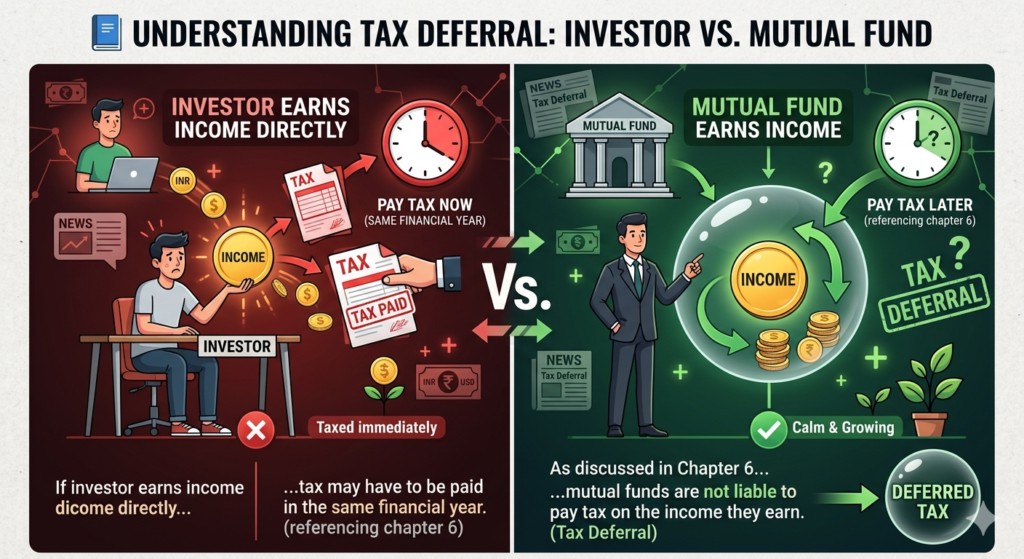
Tax deferral means delaying the payment of tax to a future date instead of paying it immediately ⏳
In the context of mutual funds:
- Mutual funds do not pay tax on the income they earn 🚫💸
- Income stays invested and keeps compounding over time 📊✨
- You pay tax only when you redeem (sell) your units 🔄💼
If you invested directly:
- Income is taxed in the same financial year 🧾📅
- This reduces the amount available for reinvestment 📉
Why tax deferral is beneficial:
- More money stays invested 💵
- Better compounding effect 📈
- Tax is postponed, improving returns ⏳🚀
Simple Example:
- Direct investment: Earn ₹10,000 → Pay tax → reinvest less 💸
- Mutual fund: Earn ₹10,000 → No immediate tax → full amount grows 📈✨
Convenient Options ⚙️💼

- Mutual fund schemes offer flexible options to match your liquidity needs 💧 and tax planning 📊
- You can:
- Withdraw partial money anytime 🔄💰
- Invest additional amounts easily ➕💵
- Set up systematic transactions like SIP, SWP, STP 🔁
Investment Comfort 😊📑
- Once you invest, further investments become very simple
- Requires minimal documentation 🧾
- Makes repeated investing quick and hassle-free 🚀
Regulatory Comfort 🛡️📘
- Mutual funds in India are regulated by Securities and Exchange Board of India
- SEBI ensures strict rules and transparency ✅
- Investors get strong protection and trust 🔒
Systematic Approach to Investments 🔁📈
Mutual funds help build discipline through:
- SIP (Systematic Investment Plan) 💵➡️📊
Invest small amounts regularly - SWP (Systematic Withdrawal Plan) 📤💰
Withdraw money regularly for income - STP (Systematic Transfer Plan) 🔄📈
Transfer money between schemes
Benefits:
- Promotes investment discipline 🧠
- Helps in long-term wealth creation 💰🚀
- SWP provides regular cash flow 💸