

Types of Mutual Funds 📊💼
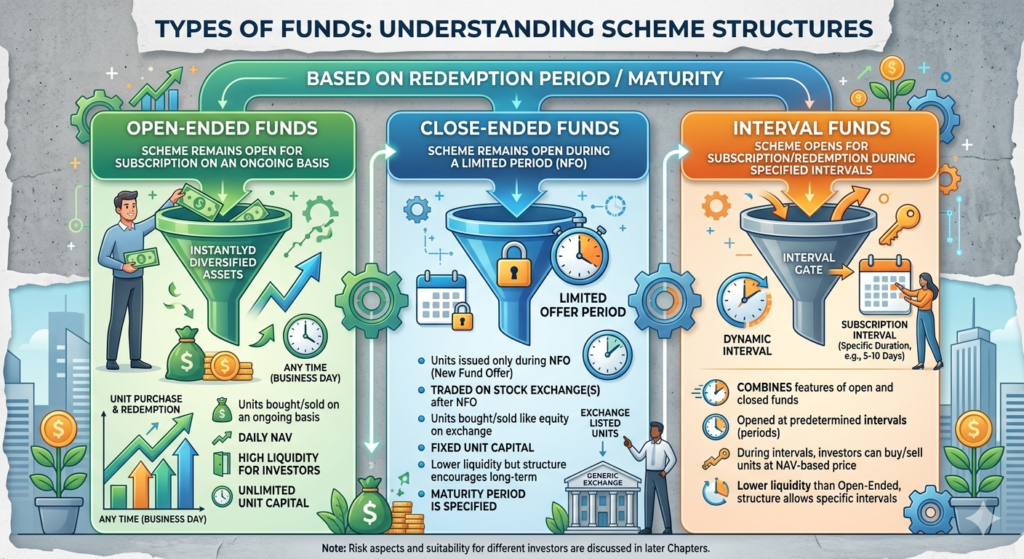
1. Open-Ended Funds, Close-Ended Funds & Interval Funds 🔄⏳
1. Open-Ended Funds 🔓📈
Meaning:
- These funds are always open for investment and redemption
Features:
- You can buy or sell anytime at NAV 💰
- No fixed maturity period ⏱️
- High liquidity 💧
Suitable for:
- Investors who want flexibility and easy access to money
2. Close-Ended Funds 🔒📅
Meaning:
- These funds are open only during the initial offer (NFO)
Features:
- Fixed maturity period (e.g., 3–5 years) ⏳
- Cannot redeem before maturity (mostly) 🚫
- Listed on stock exchange 📊
Suitable for:
- Investors who can stay invested for a fixed time
3. Interval Funds 🔁📆
Meaning:
- These are a mix of open-ended and close-ended funds
Features:
- Open for purchase/redemption only at specific intervals ⏳
- Otherwise remain closed 🔒
Suitable for:
- Investors okay with limited liquidity but periodic access
🔑 Quick Comparison
| Feature | Open-Ended 🔓 | Close-Ended 🔒 | Interval 🔁 |
|---|---|---|---|
| Liquidity | Anytime | Only via exchange | At intervals |
| Maturity | No fixed | Fixed | Partly fixed |
| Flexibility | High | Low | Medium |
📝 In Short
- 🔓 Open-ended = Flexible
- 🔒 Close-ended = Locked for a period
- 🔁 Interval = Access at specific times