
Innovation & Growth Sectors — Detailed Explanation
The highlighted point refers to structural, long-term growth areas that are expected to attract sustained capital over many years, not just short market cycles. Here’s a deeper breakdown:
🤖
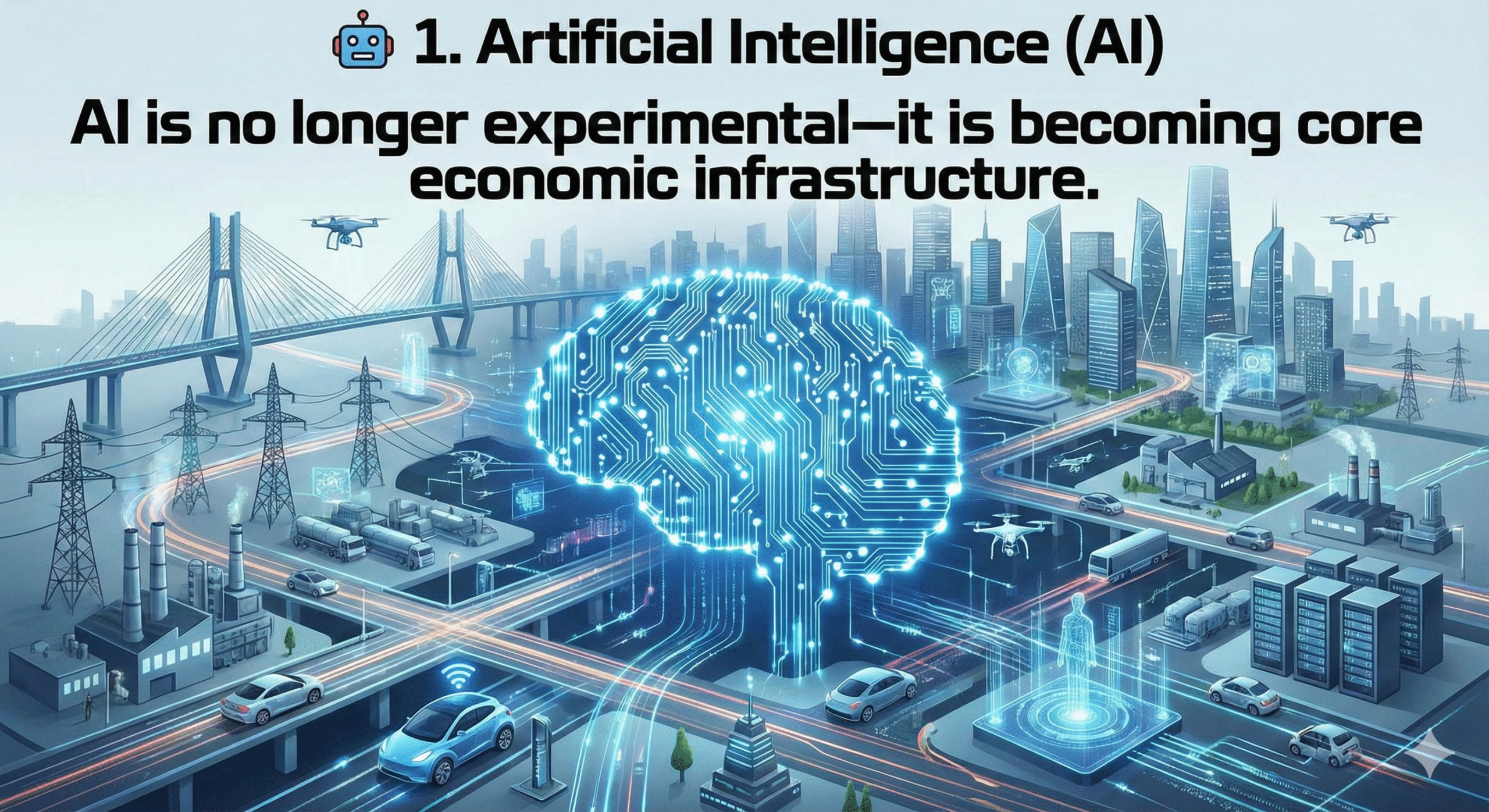
1. Artificial Intelligence (AI)
AI is no longer experimental—it is becoming core economic infrastructure.
Why it matters
- Businesses are using AI to cut costs, boost productivity, and automate decision-making
- Governments see AI as strategic for defence, healthcare, education, and governance
- Demand is rising for data centres, semiconductors, cloud services, and AI software
Where growth is happening
- Enterprise AI (banking, manufacturing, logistics)
- Generative AI tools for content, coding, and design
- AI-driven cybersecurity and fraud detection
Economic impact
- Higher productivity growth
- New high-skill jobs
- Capital flows into tech ecosystems and digital infrastructure
🏦
2. Private Markets (Private Equity & Private Credit)
Private markets are gaining importance as companies seek alternatives to public stock markets.
Why investors prefer them
- Less volatility than public markets
- Access to early-stage and high-growth companies
- Higher potential returns for long-term capital
Key trends
- Infrastructure funds financing roads, ports, data centres
- Private credit replacing traditional bank lending
- Pension funds and sovereign funds increasing exposure
Economic role
- Supports business expansion
- Funds innovation before IPO stage
- Bridges funding gaps where banks are cautious
🌱
3. Renewable Energy
Energy transition is now an economic necessity, not just an environmental goal.
Drivers
- Rising energy demand
- Energy security concerns
- Falling costs of solar, wind, and battery storage
Focus areas
- Solar and wind power projects
- Green hydrogen and energy storage
- Grid modernisation and smart energy systems
Long-term benefits
- Reduced dependence on fossil fuels
- Stable energy costs
- Job creation in clean-energy value chains
🏗️
4. Infrastructure Development
Infrastructure spending is a powerful economic multiplier.
Why it’s expanding
- Urbanisation and population growth
- Trade corridor development
- Digital and energy infrastructure needs
Key segments
- Transport: roads, railways, ports, airports
- Digital: fibre networks, data centres
- Utilities: water, power grids, waste management
Economic impact
- Boosts employment
- Improves productivity
- Attracts private and foreign investment
🌍
Why the Middle East & Europe Are in Focus
Middle East
- Diversifying away from oil-dependent economies
- Heavy investment in smart cities, AI, clean energy, and logistics
- Strong government backing and long-term capital availability
Europe
- Aggressive push toward green transition
- Large funding for renewable energy and infrastructure upgrades
- Focus on technological sovereignty and digital resilience
🔑
Big Picture
These sectors are shaping the next phase of global economic growth:
- Less cyclical, more structural
- Driven by technology, sustainability, and long-term planning
- Attractive to long-horizon investors like governments, pension funds, and institutions