
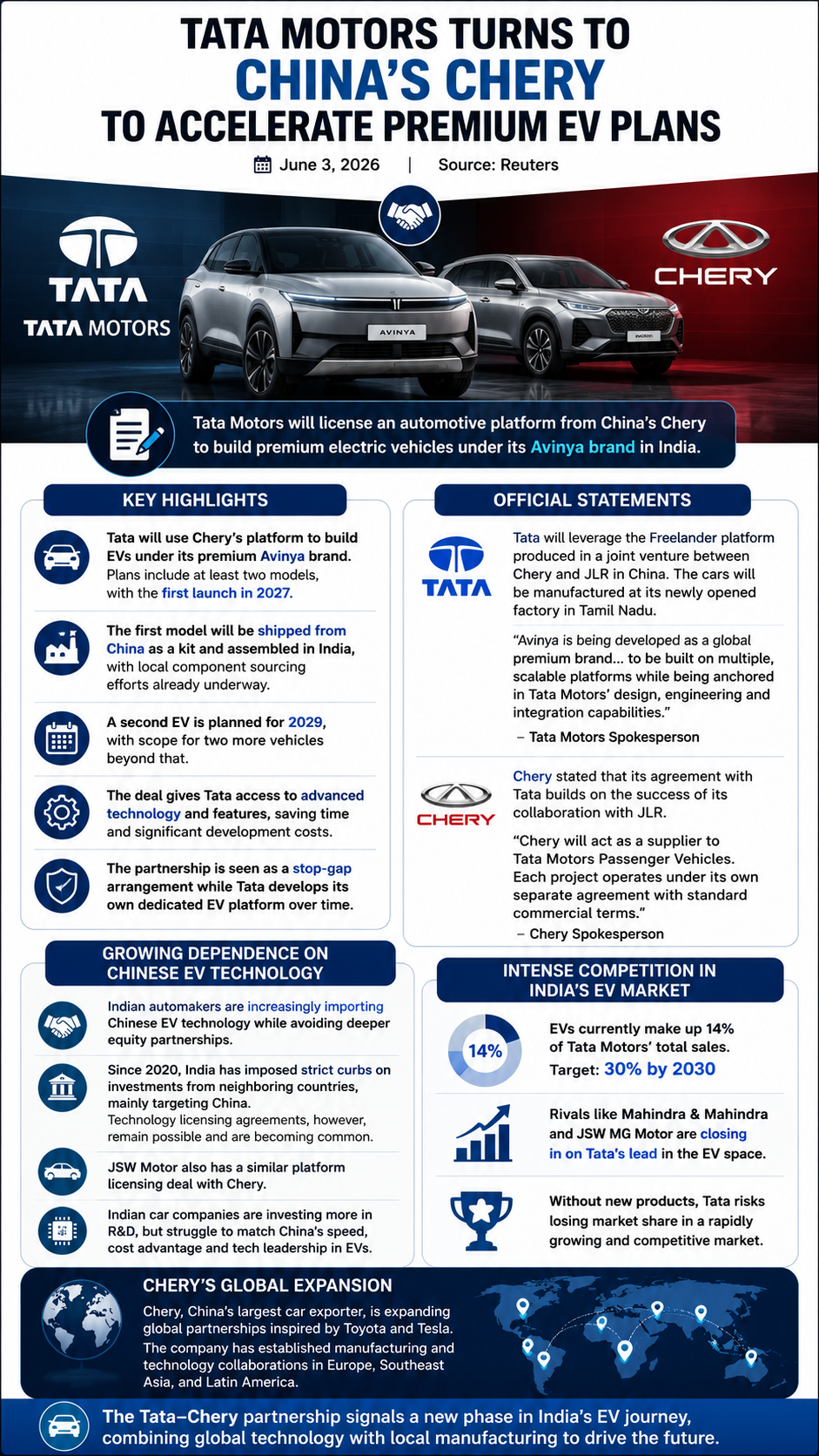
June 3, 2026
Tata Motors is partnering with Chinese automaker Chery to speed up the development of its premium electric vehicle (EV) brand, Avinya, according to sources familiar with the matter.
Under the arrangement, Tata Motors will use Chery’s vehicle platform to manufacture premium electric cars in India. The move comes after Tata’s earlier plan to build Avinya models using Jaguar Land Rover’s (JLR) Electrified Modular Architecture (EMA) was shelved when JLR decided not to manufacture EMA-based EVs in India.
First Avinya EV Expected in 2027
The first Avinya model based on Chery’s platform is expected to launch in 2027. Initially, vehicle kits will be imported from China and assembled in India, while Tata works to increase local sourcing of components.
A second model is planned for 2029, with the possibility of launching two additional vehicles later.
Tata confirmed that it will use the Freelander platform developed through a joint venture between Chery and JLR in China. Production will take place at Tata’s newly opened manufacturing facility in Tamil Nadu.
According to Tata Motors, Avinya is being developed as a global premium EV brand and will utilize multiple scalable vehicle architectures while relying on Tata’s own design, engineering, and integration expertise.
Strategic Move to Save Time and Costs
Industry sources say the partnership gives Tata access to advanced EV technology and features that would otherwise require significant investment and development time.
One source described the agreement as a temporary solution that helps Tata maintain competitiveness while it continues developing its own dedicated EV platform for the future.
Growing Dependence on Chinese EV Technology
The deal highlights a broader trend in India’s automotive sector. While Chinese automakers face restrictions on direct investments in India, Indian manufacturers are increasingly relying on Chinese technology to remain competitive in the rapidly evolving EV market.
India introduced stricter rules on investments from neighboring countries in 2020, limiting Chinese participation in several industries. However, technology licensing agreements remain possible and are becoming more common.
JSW Motor has also entered into a similar platform-licensing arrangement with Chery.
Competition Intensifies in India’s EV Market
Electric vehicles currently account for about 14% of Tata Motors’ total sales. The company aims to increase that figure to 30% by 2030.
However, competition is growing rapidly from rivals such as Mahindra & Mahindra and JSW MG Motor, which are expanding their EV portfolios and challenging Tata’s leadership position.
Despite increased investment in research and development, Indian automakers continue to face challenges matching China’s speed, scale, and technological expertise in electric vehicles.
Chery’s Global Expansion
Chery, China’s largest automobile exporter, has been expanding aggressively across international markets. Inspired by the global strategies of companies such as Toyota and Tesla, Chery has established manufacturing and technology partnerships in Europe, Southeast Asia, and Latin America.
The collaboration with Tata Motors further strengthens Chery’s global presence while helping Tata accelerate its premium electric vehicle ambitions.